
Materials for 2D and 3D quantum devices
Our goals: Understand and mitigate the key limiting mechanisms of coherence in superconducting qubits — including losses in two-level systems in oxides, non-thermal quasiparticles, and the bulk substrate — and translate those insights into the next generation of high-coherence quantum devices. The primary goal of this focused effort is to support and enable progressive hardware improvements for SQMS cavity-based quantum systems, including delivering 100+ ultrahigh-coherence chip-based superconducting transmons for the 100-qudit computing prototype, and for interconnects, communication, and sensing systems.
- Achieve 10-millisecond coherence times in chip-based superconducting 2D transmons placed inside a 3D SRF cavity, with minimal performance variation, temporal stability, and ultra-low thermal population.
- Demonstrate SRF cavities with coherence times up to seconds, targeting a cavity-qubit combined system with coherence in the hundreds of milliseconds.
- Deliver progressively higher-coherence superconducting devices — including SNAIL couplers, quantum noise limited amplifiers, and photon counters — for cavity-based computing, communication, and sensing systems.
Materials & Superconducting Characterization Efforts
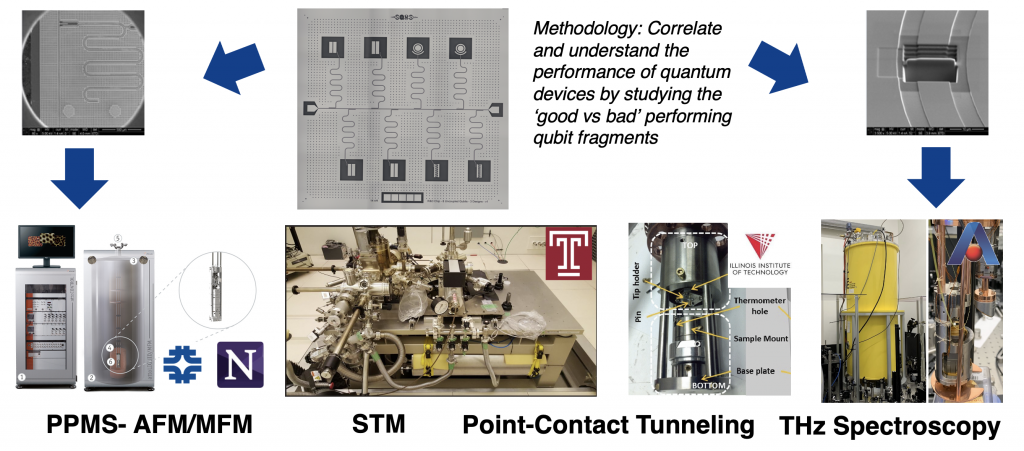
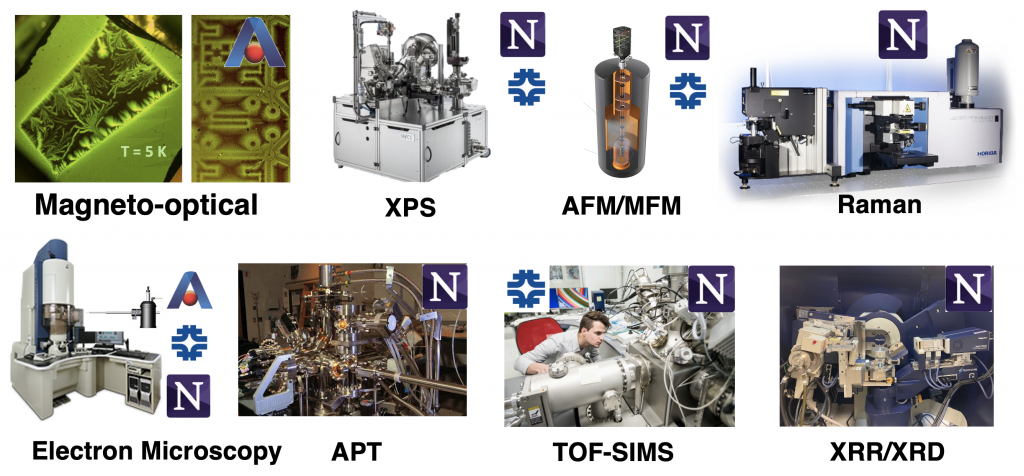
The SQMS collaboration has launched the largest systematic investigation into the origin of decoherence in quantum materials. By studying performance differences of state-of-the-art qubits with the world’s most advanced materials and superconducting characterization techniques, together with modeling efforts, the Center is building a hierarchy of loss mechanisms that informs how to fabricate the next generation of high-coherence qubits and processors. This approach has allowed SQMS to achieve dramatic improvements in energy decay times (T1) of chip-based transmons — increasing from ~10–20 µs at the outset to hundreds of microseconds and, in Year 5, in excess of 1 ms.
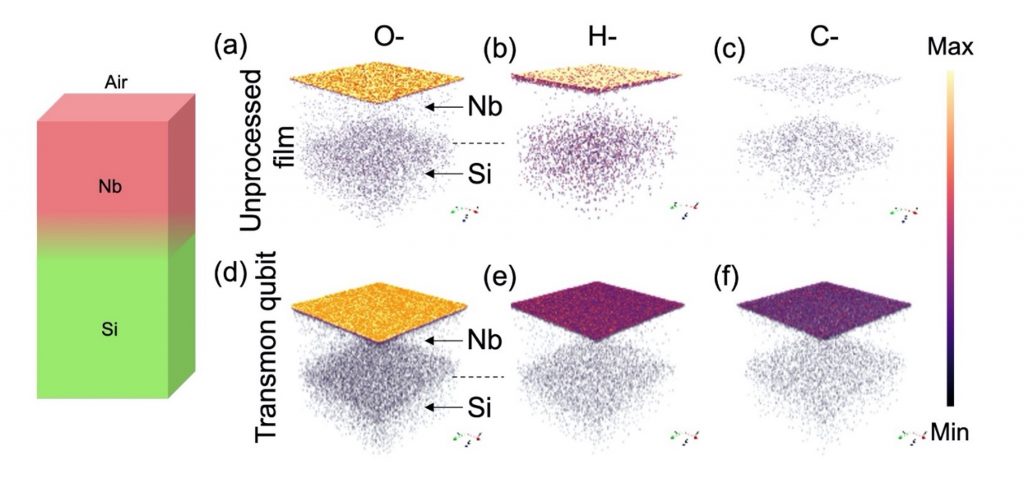
As an example, SQMS scientists used time-of-flight secondary ion mass spectrometry, ToF-SIMS, for the first time to reveal impurities such as oxygen, hydrogen, carbon, chlorine, fluorine, sodium, magnesium, and calcium by building a three-dimensional reconstruction of the qubit at the atomic level. This technique involves bombarding ions at a qubit to chip away at it. The resultant ions ejected from the qubit are detected with part-per-million sensitivities. Building on this work, SQMS researchers identified oxygen vacancies in the niobium surface oxide (Nb₂O₅) as a primary candidate for two-level system losses — supported by µSR measurements and ab initio calculations showing that oxygen vacancies introduce magnetic fluctuations and form TLS with energy splittings of 100–1000 MHz. As another example, by employing techniques such as electron microscopy, atomic force microscopy, and x-ray diffraction for the first time at cryogenic temperatures to analyze qubits, we identified nano-hydride formation as one of the factors that reduce coherence times. Recent work has further characterized niobium hydride formation from wet chemical processing and its associated noise sources. Various other advanced characterization techniques applied to state-of-the-art transmon qubits have shed light on sources of decoherence in oxides, interfaces, and substrates — including new insights into loss in high-resistivity silicon and the structure and formation mechanisms of tantalum and niobium oxides in superconducting circuits. Additional fabrication improvements include enhanced qubit performance through ammonium fluoride etching and alternating bias-assisted annealing of amorphous oxide tunnel junctions.
In SQMS 2.0, the center has continued to deepen this virtuous cycle — where insights from materials characterization inform device fabrication and testing, which in turn drive simulations and modeling of loss mechanisms — with new sub-efforts targeting transmon T2, thermal population reduction, quasiparticle mitigation, and 1/f noise.
Nanofabrication Taskforce
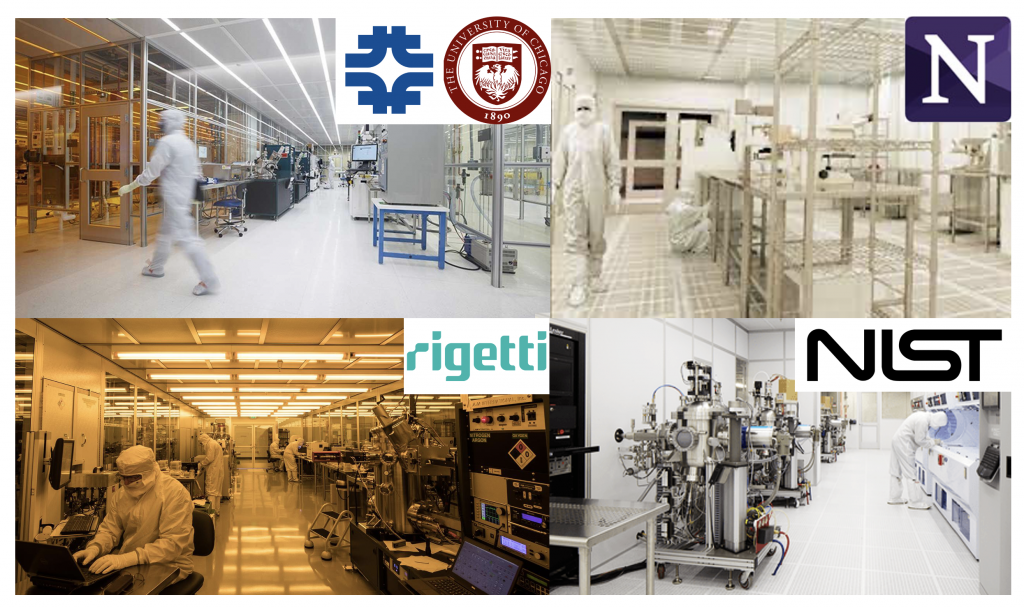
The advances in the understanding of sources of decoherence from the materials effort guide the development of new processes for quantum device fabrication. SQMS has established the first national Nanofabrication Taskforce, bringing together qubit fabrication experts from national laboratories, universities, and industry partners. In SQMS 2.0, the taskforce expands to six foundries: Fermilab/UChicago PNF, NIST, Northwestern, Rigetti Computing, Applied Materials, and NYU — working in an open, collaborative framework to uncover hidden variables, share lessons learned, and ensure systematicity and reproducibility across institutions.
Results from SQMS 1.0 include innovative fabrication techniques such as niobium surface encapsulation and silicon surface passivation, which have systematically improved the performance of transmon qubits to world-leading values. The surface encapsulation process eliminates lossy Nb₂O₅ by capping niobium surfaces with materials such as tantalum, gold, aluminum, and titanium nitride. Tantalum and gold capping yielded median relaxation times of 300 µs and best values exceeding 600 µs — nearly an order-of-magnitude improvement. By linking these improvements solely to the metal/air interface, SQMS established a loss ranking of surface oxides: Ta₂O₅ ranks as the least lossy, followed by Al₂O₃, TiO₂, and Nb₂O₅. A direct measurement of microwave loss in niobium films has provided new benchmarks for thin-film loss in these devices.
A promising new direction in SQMS 2.0 is atomic-precision processing. Atomic layer deposition (ALD), atomic layer etching (ALE), and atomic layer cleaning (ALC) offer layer-by-layer control over film thickness, composition, and interface quality — enabling more uniform surfaces, sharper interfaces, and elimination of TLS-generating defects. These methods can be integrated into existing fabrication flows, making them a practical and scalable option for improving superconducting qubit performance. A comprehensive study on the origins of qubit performance variations across 40+ researchers at Ames Lab, Northwestern, and Fermilab found that trench depth, surface oxide thickness, and sidewall geometry are the primary correlated drivers of device-to-device T1 variation — directly informing the next generation of fabrication targets. The taskforce is now working toward achieving T1 values systematically in excess of 1 ms and ultimately 10 ms.
Quantum Device Measurements
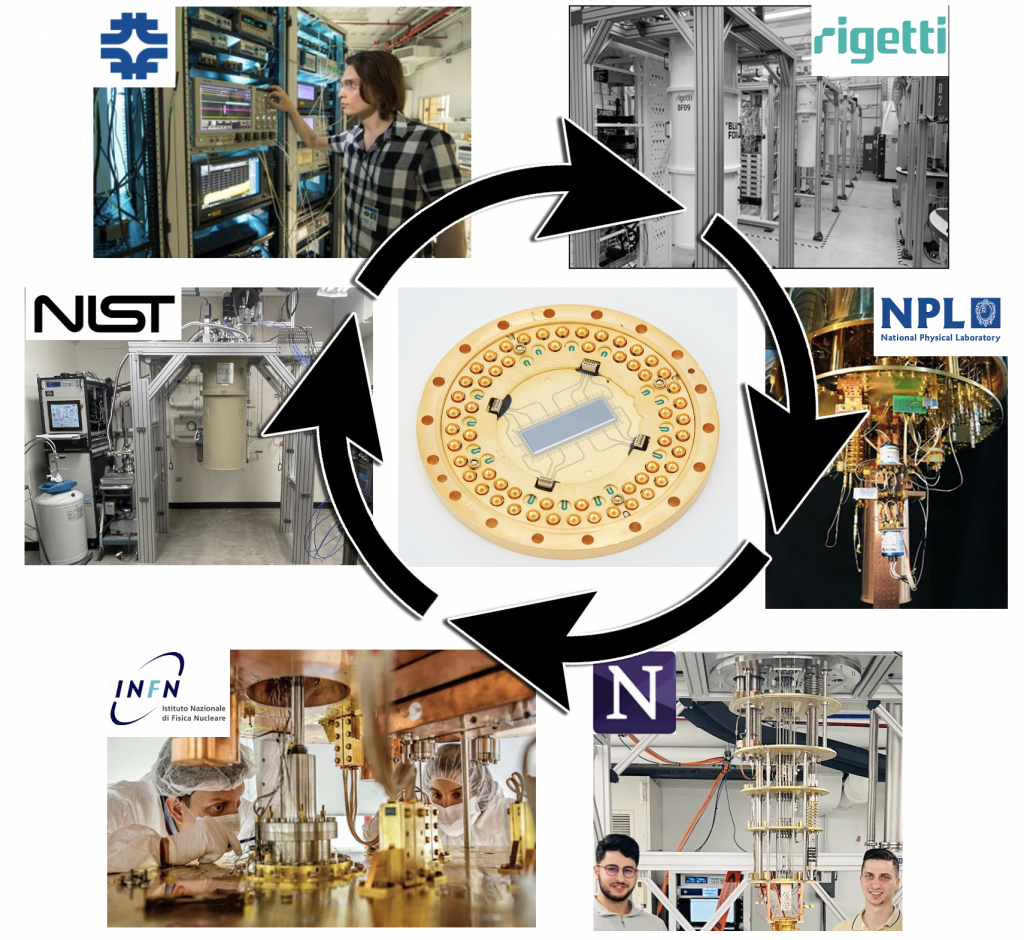
SQMS has built a comprehensive, multi-institutional framework for measuring and benchmarking the performance of superconducting quantum devices — spanning chip-based transmons, 3D SRF cavity systems, and ancilla elements. This effort encompasses standardized cross-site measurements, noise characterization, and targeted studies of the environmental and physical factors that limit device performance.
Cross-site benchmarking: from Round Robin to 3D cavity distribution
SQMS pioneered the Round Robin experiment: the first international qubit chips exchange to study and compare the performance of identical qubits at different test sites worldwide. The collaboration worked to streamline and standardize test setups, control systems, qubit fixtures, packaging, and measurement protocols. Building on SQMS 1.0, where identical 2D qubit chips were tested at Fermilab above-ground labs and INFN Gran Sasso underground labs, SQMS 2.0 expands this effort: Fermilab will manufacture and distribute multiple 3D SRF cavity/transmon measurement setups to partner institutions, focusing the collaboration on measuring coherence times and noise sources of transmon qubits placed inside a 3D SRF cavity — the architecture directly relevant to the SQMS QPU.
Partners are assigned measurement responsibilities based on their expertise. Royal Holloway University of London will focus on reducing qubit thermal population using immersion cooling down to ~1 mK, studying the impact on T1, Tϕ, and qubit frequency as a function of temperature using quantum fluids including ³He, ³He-⁴He solutions, and pure ⁴He. INFN Gran Sasso underground labs will focus on quasiparticle and cosmic ray loss mitigation. NIST, Northwestern, Rigetti, and Fermilab will perform characterization and qualification of fabricated transmons. Standards labs such as NIST and the National Physical Laboratory (NPL) in the UK are key contributors to measurement reproducibility and traceability.
Environmental and radiation effects
The underground INFN Gran Sasso facilities enable direct comparison with above-ground sites to quantify the effects of environmental radiation, including cosmic-ray-induced quasiparticle bursts and radioactivity from the chip package and fridge environment. SQMS conducted the world’s first round-robin experiments exchanging identical qubits between Fermilab and Gran Sasso, experimentally quantifying the magnitude of cosmic-ray-induced quasiparticle bursts and the effects of other radiation forms. In SQMS 2.0, controlled experiments will subject transmons to electric and magnetic fields, mechanical vibrations, and ionizing radiation to identify triggering mechanisms for quasiparticle burst events — which cause abrupt T1 degradation lasting several milliseconds and can compromise quantum error correction.
Magnetic field and thermal effects
The SQMS Fermilab group has performed experimental work quantifying the effect of trapped magnetic flux at 10 mK and 6 GHz for both niobium cavities and transmon qubits. Initial studies revealed that SQMS transmon qubits are robust up to field strengths of 600 mG, and that applying or trapping a magnetic field reduces the spread and time variation of T1 — a promising avenue for stabilizing ancilla transmon performance that will be actively pursued in SQMS 2.0. Experimental work using pump-probe spectroscopy in the presence of an applied magnetic field also revealed a clear correlation between non-equilibrium quasiparticle density and the structural properties of superconducting niobium samples. New work has further examined trapped magnetic vortex losses in niobium resonators at millikelvin temperatures, providing a deeper accounting of extrinsic loss sources.
Noise characterization
Device measurements at SQMS encompass systematic characterization of multiple noise sources — including two-level-system (TLS) losses, quasiparticle-induced errors, and 1/f noise — to disentangle their individual contributions to decoherence. Studies will quantify the impact of 1/f noise from control electronics on transmon coherence and gate fidelities, and investigate the microscopic origins of intrinsic 1/f noise in both fixed-frequency and tunable-frequency transmons. Additionally, the relationship between effective qubit temperature and average T1 and temporal stability — particularly in the sub-mK temperature regime — remains an open question that SQMS 2.0 measurement campaigns will directly address.