
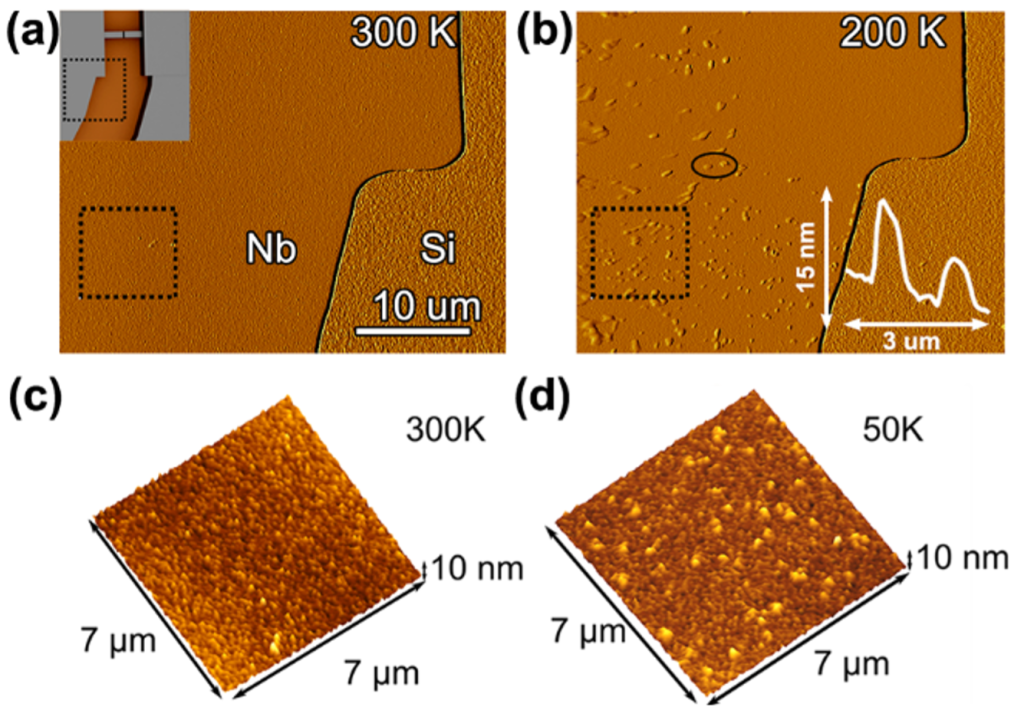
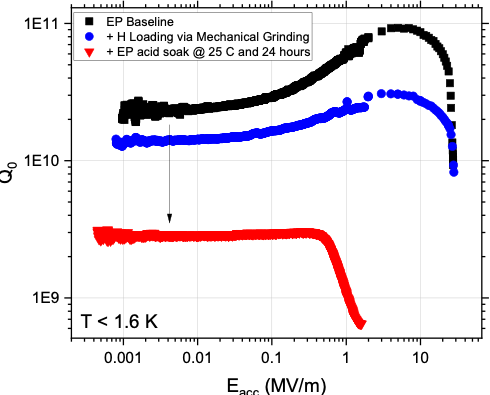
(a-d) Atomic force microscopy (AFM) surface images of Nb films at (a, c) room temperature, and (b, d) at cryogenic temperatures with the formation of the topographical features on the surface of Nb clearly evident in the latter situation; (e) Our findings indicate that increasing free hydrogen concentration in the cavity walls by an approximate factor of 2.5 results in a nearly ten-fold reduction in the low-field quality factor, likely due to an increased volume fraction of niobium hydrides.
Image credit: Fermilab
The Science
Following similar studies on 3D superconducting RF niobium resonators, we employ characterization techniques including atomic force microscopy and hard X-ray diffraction at cryogenic temperatures to reveal the presence and structure of niobium hydride precipitates on the surface of superconducting qubits.
The Impact
Based on 3D superconducting RF Nb resonator studies at low power and temperature, we find that niobium hydrides likely contribute to microwave losses in superconducting qubits in the form of quasiparticle dissipation and may contribute to cooldown-to-cooldown variability and long-term aging.
Summary
We report the evidence of the niobium hydride precipitate formation in superconducting qubits fabricated at Rigetti Computing. For this study, we combined complementary techniques, including room-temperature and cryogenic atomic force microscopy (AFM), synchrotron X-ray diffraction, and time-of-flight secondary ion mass spectroscopy (ToF-SIMS), to directly reveal the existence of niobium hydride precipitates. Upon cryogenic cooling, we observed variations in the size and morphology of the hydrides, ranging from small (~5 nm) irregular shapes to large (~10-100 nm) domains within the Nb grains. Since niobium hydrides are non-superconducting and vary in size and location as a function of cooling down to cryogenic temperature, our finding highlights a previously unknown source of decoherence in superconducting qubits. Finally, by leveraging the RF performance of a 3D bulk Nb resonator, we can quantify RF dissipation introduced by niobium hydrides in superconducting qubits and find that these defects likely contribute to quasiparticle losses.
Institutions
Fermilab, Rigetti Computing
Citation
Z-H Sung, D. Bafia, A. Cano, A. Murthy, J-Y Lee, M. J. Reagor, J. Rubio-Zuazo, A. Grassellino, A. Romanenko. “Discovery of Niobium Hydride Precipitates in Superconducting Qubits”, Phys. Rev. Materials 10, 016201 (2026). https://doi.org/10.1103/mgnw-kjps
Funding Acknowledgement
This work was supported by the U.S. Department of Energy, Office of Science, National Quantum Information Science Research Centers, Superconducting Quantum Materials and Systems Center (SQMS), under Contract No. 89243024CSC000002. Fermilab is operated by Fermi Forward Discovery Group, LLC under Contract No. 89243024CSC000002 with the U.S. Department of Energy, Office of Science, Office of High Energy Physics. We acknowledge the Spanish Ministerio de Ciencia, Innovación y Universidades and Consejo Superior de Investigaciones Científicas for financial support through the Projects 2010 6 0E 013 and 2021 60 E 030, and for the provision of synchrotron radiation facilities at BM25-SpLine at the ESRF. This work made use of the EPIC, Keck-II, and/or SPID facilities of Northwestern University’s NUANCE Center, which received support from the Soft and Hybrid Nanotechnology Experimental (SHyNE) Resource (NSF ECCS-1542205); the MRSEC Program (NSF DMR- 3541121262) at the Materials Research Center; the International Institute for Nanotechnology (IIN); the Keck Foundation; and the State of Illinois, through the IIN.

Diagram of the test for nonlinear quantum mechanics. A qubit is prepared in a superposition and then measured, resulting in two possible outcomes, or worlds. In World 1, the qubit is measured in state |1⟩ and a voltage V0 is applied; in World 0, the qubit is measured in state |0⟩ and the voltage source is off, but the voltage is measured. If the nonlinear quantum mechanics theory is correct, a small voltage may appear in World 0, even though the source is off, due to leakage from World 1.
Graphic credit: Fermilab
The Science
Linearity of time evolution is a key axiom of quantum mechanics. However, recent theory work has shown that logically consistent non-linear quantum time evolution is possible. This work demonstrates interactions between different arms of a superposition to persist even when the arms are quantum incoherent. A test of this theory is based on measurements of a quantum bit using a RF source or a RF detector and the leakage of the RF power from one arm of the superposition to the other. This setup improved the limit of detection on such nonlinearities by a factor of 50.
The Impact
All modern physics is built on the core principles of quantum mechanics. These phenomenologically derived principles dictate what is technologically possible. If nature appears to violate one of these principles, it could lead to a new set of technologies that were otherwise thought impossible. A positive signal in this experiment would herald a new approach to massive parallelization of classical resources, enabling vastly more powerful computing devices.
Summary
Recent theory work has shown that it is easy to extend quantum field theory to include non-linear evolution. Excitingly, this work showed that prior bounds on causal non-linearities were weak but that they could be readily probed by experiments. This work showed that causal non-linearities robustly require communication between different branches of the wave-function, even when these branches are quantum incoherent. This hypothesis can be tested on the outcome of a quantum spin using a RF source and detector simultaneously. This creates a quantum incoherent superposition where the RF source is turned on in one branch of the wave function and the RF detector is turned on in the other part of the wave function. If present, these non-linearities permit leakage of RF power from one branch to the other. This experiment improved current bounds on such non-linearities by a factor of 50. A positive signal in this experiment would revolutionize technology, allowing for the instant parallelization of massive classical resources to tackle a variety of computing problems.
Contact
Surjeet Rajendran, Johns Hopkins University
surjeet@jhu.eduFocus Area
Quantum sensing for fundamental physics
Institutions:
Fermi National Accelerator Laboratory, Johns Hopkins University
Citation
Oleksandr Melnychuk, Bianca Giaccone, Nicholas Bornman, Raphael Cervantes, Anna Grassellino, Roni Harnik, David E. Kaplan, Geev Nahal, Roman Pilipenko, Sam Posen, Surjeet Rajendran, Alexander O. Sushkov, Improved bound on nonlinear quantum mechanics using a cryogenic radio frequency experiment, 2025 Phys. Rev. D 112, 012020
DOI: https://doi.org/10.1103/gkg6-fqsc
Funding Acknowledgement
This material is based upon work supported by the U.S. Department of Energy, Office of Science, National Quantum Information Science Research Centers, Superconducting Quantum Materials and Systems Center (SQMS) under contract number DE- AC02-07CH11359.