
Discovery of Niobium Hydride Precipitates in Superconducting Qubits
This study provides evidence regarding the formation of non-superconducting niobium hydride phases within superconducting qubits at cryogenic temperatures.
The Science:
Following similar studies on 3D superconducting RF niobium resonators, we employ characterization techniques including atomic force microscopy and hard X-ray diffraction at cryogenic temperatures to reveal the presence and structure of niobium hydride precipitates on the surface of superconducting qubits.
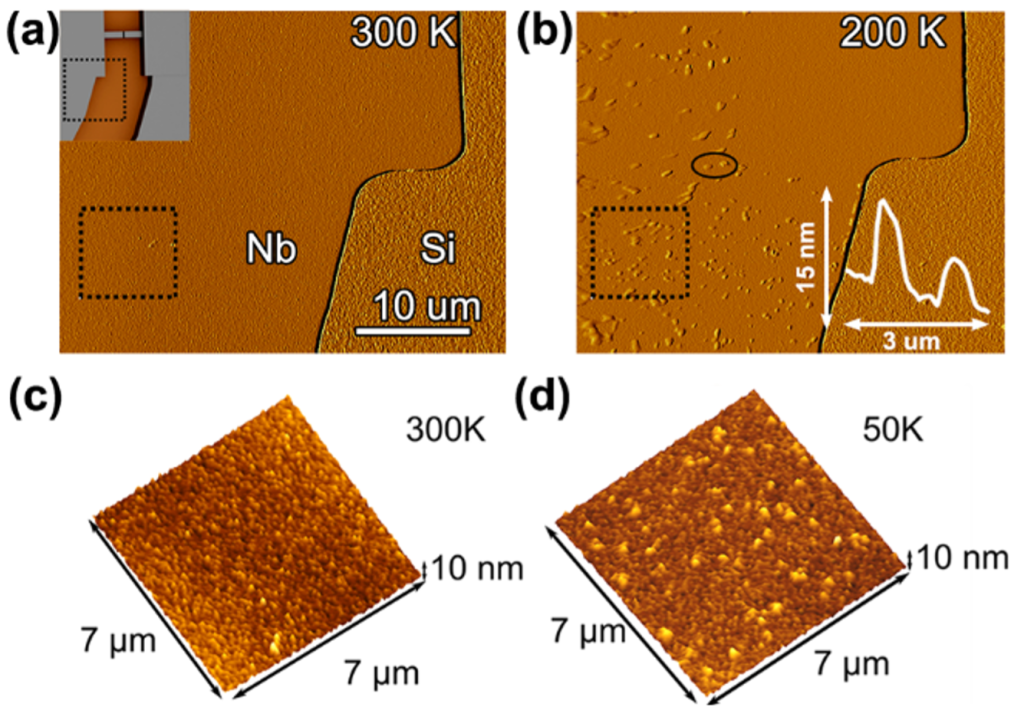
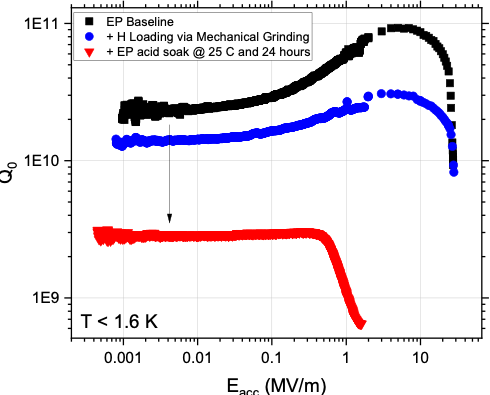
(a-d) Atomic force microscopy (AFM) surface images of Nb films at (a, c) room temperature, and (b, d) at cryogenic temperatures with the formation of the topographical features on the surface of Nb clearly evident in the latter situation; (e) Our findings indicate that increasing free hydrogen concentration in the cavity walls by an approximate factor of 2.5 results in a nearly ten-fold reduction in the low-field quality factor, likely due to an increased volume fraction of niobium hydrides.
The Impact:
Based on 3D superconducting RF Nb resonator studies at low power and temperature, we find that niobium hydrides likely contribute to microwave losses in superconducting qubits in the form of quasiparticle dissipation and may contribute to cooldown-to-cooldown variability and long-term aging.
Summary:
We report the evidence of the niobium hydride precipitate formation in superconducting qubits fabricated at Rigetti Computing. For this study, we combined complementary techniques, including room-temperature and cryogenic atomic force microscopy (AFM), synchrotron X-ray diffraction, and time-of-flight secondary ion mass spectroscopy (ToF-SIMS), to directly reveal the existence of niobium hydride precipitates. Upon cryogenic cooling, we observed variations in the size and morphology of the hydrides, ranging from small (~5 nm) irregular shapes to large (~10-100 nm) domains within the Nb grains. Since niobium hydrides are non-superconducting and vary in size and location as a function of cooling down to cryogenic temperature, our finding highlights a previously unknown source of decoherence in superconducting qubits. Finally, by leveraging the RF performance of a 3D bulk Nb resonator, we can quantify RF dissipation introduced by niobium hydrides in superconducting qubits and find that these defects likely contribute to quasiparticle losses.
Contact:
Zu Hawn Sung, zsung@fnal.gov
Focus Area(s):
Technology
Institutions:
Fermilab, Rigetti Computing
Citation:
Z-H Sung, D. Bafia, A. Cano, A. Murthy, J-Y Lee, M. J. Reagor, J. Rubio-Zuazo, A. Grassellino, A. Romanenko. “Discovery of Niobium Hydride Precipitates in Superconducting Qubits”, Phys. Rev. Materials 10, 016201 (2026). https://doi.org/10.1103/mgnw-kjps
Funding Acknowledgement:
This work was supported by the U.S. Department of Energy, Office of Science, National Quantum Information Science Research Centers, Superconducting Quantum Materials and Systems Center (SQMS), under Contract No. 89243024CSC000002. Fermilab is operated by Fermi Forward Discovery Group, LLC under Contract No. 89243024CSC000002 with the U.S. Department of Energy, Office of Science, Office of High Energy Physics. We acknowledge the Spanish Ministerio de Ciencia, Innovación y Universidades and Consejo Superior de Investigaciones Científicas for financial support through the Projects 2010 6 0E 013 and 2021 60 E 030, and for the provision of synchrotron radiation facilities at BM25-SpLine at the ESRF. This work made use of the EPIC, Keck-II, and/or SPID facilities of Northwestern University’s NUANCE Center, which received support from the Soft and Hybrid Nanotechnology Experimental (SHyNE) Resource (NSF ECCS-1542205); the MRSEC Program (NSF DMR- 3541121262) at the Materials Research Center; the International Institute for Nanotechnology (IIN); the Keck Foundation; and the State of Illinois, through the IIN.