
Building the Infrastructure for Scaling Quantum Hardware
Our goals: Develop the cryogenic infrastructure required to house and operate next-generation superconducting quantum systems at scale, from single-processor platforms to interconnected quantum data centers, leveraging Fermilab’s decades of expertise in large-scale cryogenic engineering.
- Develop energy-efficient, liquid-helium cryoplant-based cooling solutions suited for future large-scale quantum data centers.
- Prototype the full cryogenic and microwave infrastructure required to interconnect multiple quantum processors within a single scalable facility.
From Accelerators to Quantum Computers
The SQMS Center is rooted in Fermilab’s expertise in superconducting radio-frequency cavities, materials, and cryogenics, technologies originally developed for particle accelerators. That legacy now underpins one of the most ambitious engineering efforts in quantum information science: building the cryogenic systems capable of housing the next generation of quantum computers.
Superconducting quantum devices must operate at temperatures around 10 millikelvin, roughly 10,000 times colder than liquid argon and approximately 100 times colder than outer space. A dilution refrigerator achieves these temperatures not through mechanical compression, as in a conventional refrigerator, but through a quantum mechanical process called phase separation. When helium-3 is diluted into helium-4 at temperatures below approximately 870 millikelvin, the mixing of the two isotopes absorbs heat, driving the system to millikelvin temperatures in a continuous closed-loop cycle. Commercial dilution refrigerators used for quantum research today typically provide cold volumes on the order of a few tens of liters and cooling powers in the microwatt range at 10 mK. Scaling these systems to host the hundreds or thousands of qubits needed for practical quantum computing requires a fundamentally different engineering approach, one that SQMS is pioneering by drawing directly on Fermilab’s accelerator infrastructure and cryogenic engineering expertise.
Toward a Scalable Quantum Data Center
Building a large-scale quantum computer requires more than coherent qubits. It requires the infrastructure to house and connect them. In addition to improved qubits, a comprehensive, scalable infrastructure is needed to house and run them at temperatures close to absolute zero.
SQMS is directly addressing this challenge as a central goal of its second phase by developing a liquid-helium cryoplant-based, energy-efficient cooling solution purpose-built for quantum data center environments, where power efficiency and thermal stability at scale are critical requirements.
Existing Cryogenic Facilities at Fermilab
Critical facilities available for testing, enabling techniques for scaling up to large quantum computing data centers
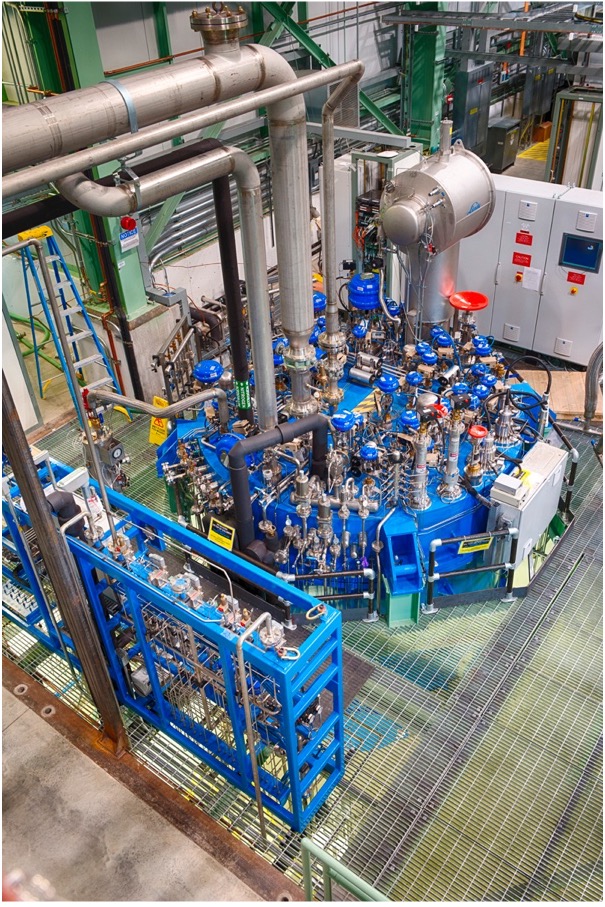
Cryomodule Test Facility (CMTF) liquid Helium cryogenics plant
The CMTF cryogenic system is supplied by a state-of-the-art Superfluid Cryogenic Plant, which provides 40K, 5K, and 2K helium at up to 500 W. 2K operations are achievable through either cold or warm compression systems. This system currently supports the Cryo Module Test Stand 1 (CMTS1) used to test 1.3 GHz & 3.9 GHz cryomodules for the LCLS-II project, as well as the PIP-II Injection Test Stand (PIP-II IT) program to test the front end of the future PIP-II Linac.
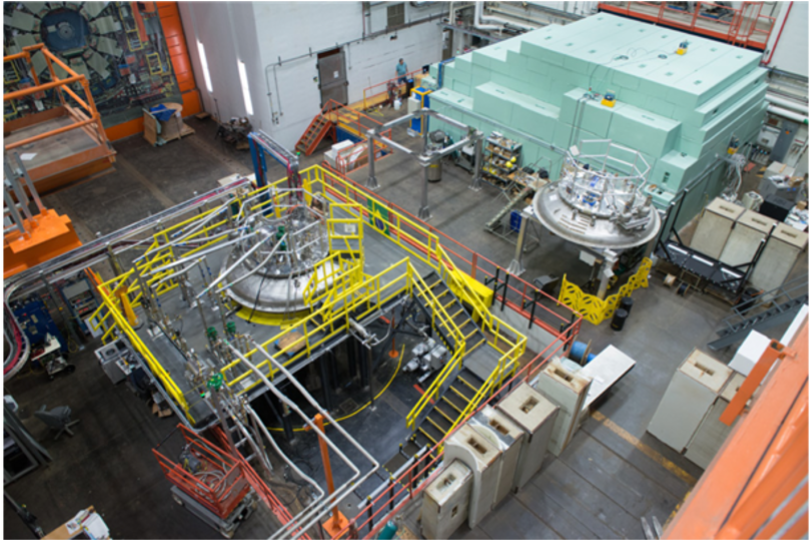
Heavy Assembly Building (HAB) liquid Helium cryogenics plant
The helium cryogenic system consists of two Mycom screw compressors (60 g/s) supporting a 625 Watt at 4.5 K cryogenic plant that was previously used for the Collider Detector at Fermilab (CDF) experiment and the testing of solenoid magnet modules for Mu2e.
Cryogenics Partners
SQMS’s cryogenics effort draws on a unique combination of in-house Fermilab infrastructure and deep industry partnerships with Maybell Quantum Industries and Bluefors.