Scaling quantum systems from discovery to deployment
The Superconducting Quantum Materials and Systems (SQMS) Center is advancing into its next phase of innovation following a $125 million renewal from the U.S. Department of Energy. Building on five years of record-breaking progress, SQMS 2.0 is focused on scaling quantum systems by creating a seamless pipeline linking fundamental discovery to practical deployment.
By leveraging Fermilab’s world-leading expertise in superconducting radio-frequency (SRF) technology and materials science, we are bridging the gap between basic research and the realization of beyond-state-of-the-art quantum platforms for computing and sensing.
The Three Strategic Pillars of SQMS 2.0
The SQMS research mission is driven by three major efforts that integrate fundamental science with system-level scaling:
1. Advancing Materials for Record Coherence
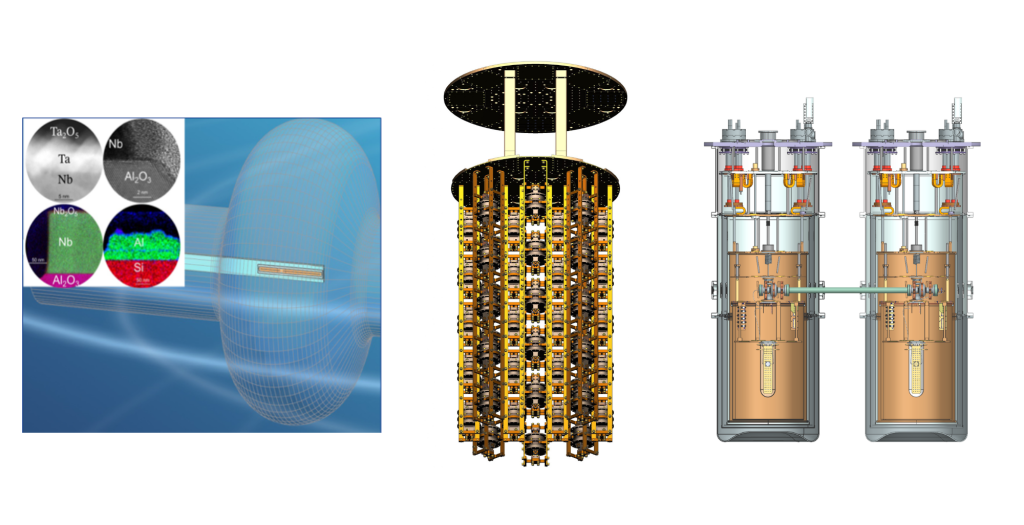
SQMS will continue to pursue new materials and fabrication methods to deliver progressively higher-coherence superconducting devices for cavity-based computing, communication and sensing systems. The center aims to achieve the ambitious goal of 10-millisecond coherence for chip-based transmon qubits, providing the fundamental foundation for more reliable quantum hardware.
2. Development of a 100-qudit SRF quantum processor at Fermilab
SQMS is uniquely positioned to scale quantum computing through our 3D-cavity, qudit-based architecture. Utilizing Fermilab’s ultra-high-Q SRF cavities, we are developing a 100-qudit prototype. This approach leverages the multi-level nature of qudits to achieve a computational space equivalent to approximately 500 qubits. The platform will serve as a unique facility for computing and sensing experiments.
3. Demonstration of the first scalable quantum data-center unit
To enable future quantum data centers with thousands of qubits, SQMS will prototype the cryogenic and microwave infrastructure required for interconnection. This includes high-fidelity, cavity-based links and a liquid-helium cryoplant-based, energy-efficient solution for large-scale distributed quantum computing systems.
Applications in Fundamental Science
SQMS technological breakthroughs will also enable opportunities to advance fundamental science. High-coherence chips made at SQMS will be explored for demonstrating record sensitivity magnetometry for materials science and as wide-band dark matter photon counters to probe QCD axions. The qudit advantage of high coherence cavity-qubit systems will be explored for simulating high-energy physics problems with an emphasis on lattice gauge theories and will be exploited to accelerate dark matter searches. Hybrid 4 K-mK quantum systems will serve as platforms to probe fundamental physics phenomena with greater sensitivity. Opportunities that will be pursued and demonstrated include detection of high frequency gravitational waves, light axion dark matter, and new gyroscope-based concepts.
A Unified Research Ecosystem
The SQMS mission involves a multidisciplinary coalition of over 300 experts from 43 partner institutions. By uniting the research capabilities of national labs and academia with the scaling expertise of industry leaders, we are ensuring that every discovery has a direct path to deployment.
